





What is a white noise back up alarm
 May 28, 2026|
 View:453
Every year, reversing vehicle accidents claim lives and destroy property across construction sites, warehouses, loading docks, and city streets. For decades, the solution seemed simple: mount a loud beeper on the back of the vehicle and let everyone nearby know it is moving in reverse. But that solution has proven deeply flawed. Traditional backup alarms produce a monotonous, high-pitched beep that people quickly learn to ignore — a psychological phenomenon known as alarm fatigue. The brain adapts to repetitive, persistent sounds and tunes them out, rendering the very device meant to save lives dangerously ineffective. Enter the white noise back up alarm — a revolutionary safety technology that replaces the annoying beep-beep with a broadband, whooshing sound that is far easier to hear, far easier to locate, and far less likely to be ignored. If you have ever heard the distinctive "ssh-ssh-ssh" of a delivery truck backing up in your neighborhood, you have already experienced a white noise back up alarm in action. This article explores what makes the white noise back up alarm superior to its predecessor, how it works, and why it is rapidly becoming the standard for vehicle safety worldwide.
The Problem with Traditional Backup Alarms
To understand why the white noise back up alarm exists, you must first understand what is wrong with the old system. Traditional backup alarms emit a pure tone — typically around 1,000 Hz — at volumes between 97 and 112 decibels. That is louder than a chainsaw. While this might seem effective on paper, reality tells a different story. Research has shown that workers on busy job sites become deaf to the beeping noise within minutes. The constant, unchanging tone triggers what psychologists call the "cry wolf" effect: because the alarm sounds all the time, even when no real danger exists, people stop responding to it. Studies confirm that reversing vehicles now account for a quarter of all workplace deaths, with 90 percent of those accidents occurring off-road in loading bays, parking lots, quarries, and warehouses. The very device designed to prevent these tragedies has, in many cases, become part of the problem.
Beyond ineffectiveness, traditional alarms are also a significant source of noise pollution. Municipalities and residents near construction zones have long complained about the relentless beeping that can be heard blocks away. OSHA regulation 1926.602(a)(9)(ii) requires that earthmoving or compacting equipment with an obstructed rear view must have a reverse signal alarm distinguishable from surrounding noise — a standard that traditional beepers increasingly fail to meet in practice.
How a White Noise Back Up Alarm Works
A white noise back up alarm operates on an entirely different acoustic principle. Instead of emitting a single-frequency tone, it broadcasts sound across a wide range of frequencies simultaneously — a broadband signal that mimics the spectral characteristics of white noise. In physics, white noise is defined as a random signal with equal power across all frequencies, much like white light contains all colors of the spectrum. The result is a pulsing "psss-psss" or "ssh-ssh" sound that is rich, textured, and unmistakable.
This broadband design gives the white noise back up alarm three critical advantages. First, the sound is instantly locatable. Because it contains multiple frequencies, the human ear can pinpoint the direction and distance of the source far more accurately than with a single-tone beep. Second, the white noise back up alarm cuts through background noise more effectively. On a noisy construction site where jackhammers, engines, and machinery create a wall of sound, a traditional beep gets buried. The broadband frequencies of a white noise back up alarm rise above that chaos. Third, and perhaps most importantly, people do not habituate to it. The brain is wired to process natural, dissipating sounds — like waves breaking or wind rustling — far more readily than artificial, repetitive tones. This means the white noise back up alarm maintains its warning power even after hours of continuous use.
Real-World Performance and Specifications
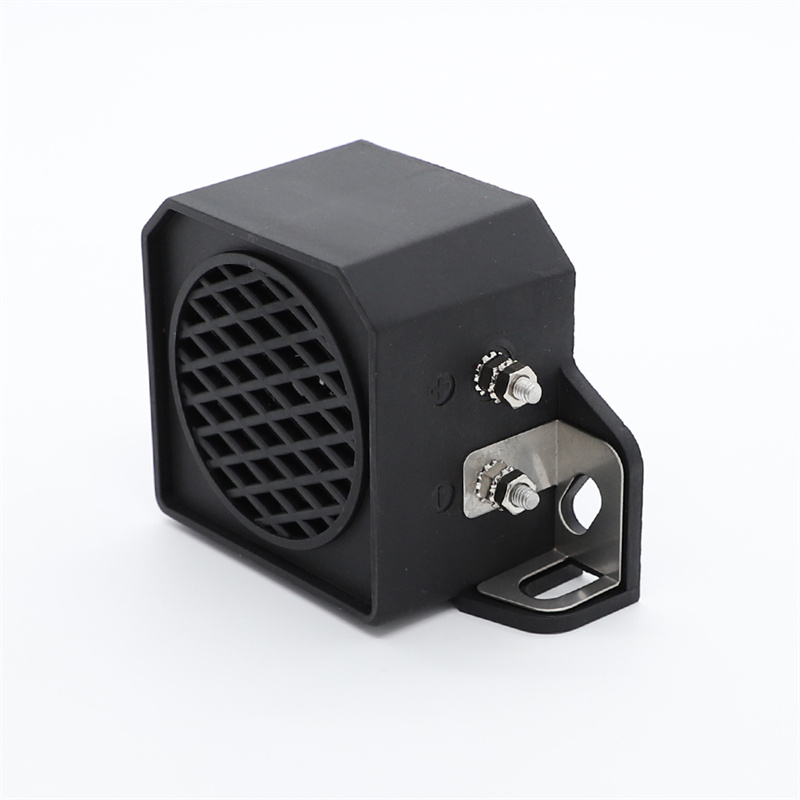
Modern white noise back up alarm units are engineered for extreme durability. Many models feature sealed epoxy housings, glass-filled nylon construction, and IP67 waterproof ratings, making them suitable for the harshest outdoor conditions. Voltage ranges typically span 12–24 VDC, with some heavy-duty models accepting 10–80 VDC, ensuring compatibility with everything from delivery vans to utility trucks and heavy equipment.
In terms of volume, white noise back up alarm devices generally operate between 85 and 112 decibels, with 97 dB, 102 dB, and 107 dB being the most common ratings. This range strikes a careful balance: loud enough to be heard over ambient noise and to penetrate hearing protection worn by workers, yet not so loud as to cause the hearing damage associated with traditional 112 dB beepers. The recommended setting for most applications falls between 85 and 95 decibels — effective for safety while minimizing environmental impact.
The directional nature of the white noise back up alarm also means that the sound does not travel unnecessarily far. Unlike a traditional beeper that can be heard 200 feet or more away, the broadband whoosh is primarily audible to those directly in or near the vehicle's path. This makes the white noise back up alarm an ideal choice for residential areas, urban delivery routes, and any environment where noise pollution is a concern.
Why the White Noise Back Up Alarm Is the Future
The shift from beep to broadband is not merely a preference — it is a safety imperative. As reversing accidents continue to be a leading cause of struck-by injuries on job sites across North America, the industry has recognized that technology must evolve. Multiple manufacturers now produce white noise back up alarm units that meet SAE J994 standards (Type A, C, and F) and OSHA requirements. Municipal regulations in many cities now mandate or strongly encourage the use of white noise back up alarm systems over traditional beepers, particularly in residential and downtown zones where noise complaints are rampant.
The white noise back up alarm also benefits workers wearing hearing protection. Because the signal spans multiple frequencies, it is not easily blocked by ear defenders the way a single-tone alarm is. This is a massive advantage in environments where hearing protection is mandatory. Furthermore, studies have shown that the broadband sound of a white noise back up alarm is more accessible to individuals with hearing difficulties, broadening its protective reach.
Conclusion
The white noise back up alarm represents a fundamental leap forward in vehicle safety technology. By replacing the outdated, ignored, and noisy beep-beep with a broadband whooshing sound, the white noise back up alarm delivers warnings that people actually hear, actually locate, and actually respond to. It reduces noise pollution, complies with evolving regulations, protects workers even when they wear hearing protection, and dramatically lowers the risk of reversing accidents. Whether you are managing a fleet of delivery trucks, operating heavy machinery on a construction site, or simply want a safer vehicle for daily use, the white noise back up alarm is the clear, modern choice. The evidence is overwhelming: the white noise back up alarm works where traditional alarms fail, and its adoption is no longer optional — it is essential. Every vehicle that reverses should be equipped with a white noise back up alarm, because in the matter of safety, there is no substitute for a sound that people cannot afford to ignore.





View More(Total0)Comment lists