


How to choose an acoustic vehicle alerting system for electric vehicles
 Nov 25, 2026|
 View:21
What actually matters when you select an acoustic vehicle alerting system for an electric vehicle? Four pillars decide it: technical performance, application fit, regulatory compliance, and cost.
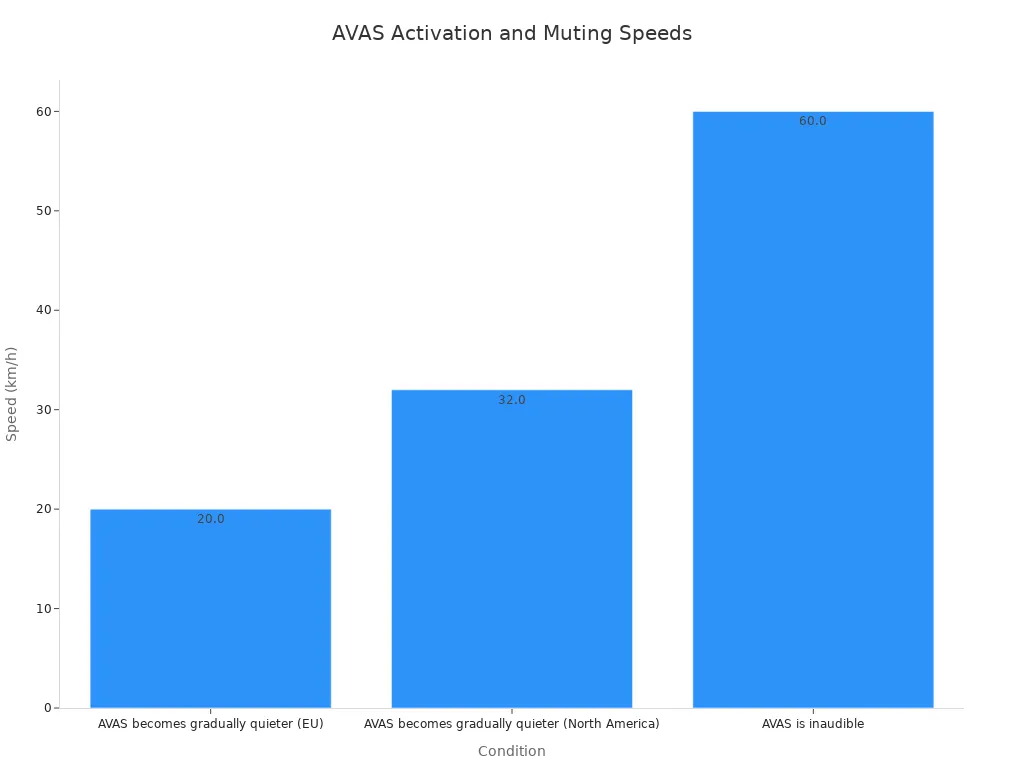
An AVAS works at low speeds, when stationary, and in reverse. It mutes at higher speeds to avoid unnecessary noise. Regional rules differ, as the chart below shows.
This post gives you a step-by-step decision framework. You will not wade through background theory.
Key Takeaways
Check the AVAS sound pressure and frequency range to ensure it cuts through traffic noise and is easy to locate.
Match the AVAS to your vehicle type and electrical system for a smooth fit and reliable performance.
Verify regulatory compliance with documents, not marketing claims, to avoid costly approval failures.
Weigh total cost of ownership, including installation and warranty, not just the purchase price.
Follow the order: confirm compliance and fit first, then optimize cost for a successful AVAS selection.
Acoustic vehicle alerting system performance
Sound pressure and frequency
Start with sound pressure level. Measure the output at a defined distance and compare it against the background noise of your target environment. Day and night modes matter here. A daytime level must cut through traffic; a nighttime level should warn without waking a residential street. Check both figures on the datasheet, not just the peak.
Frequency range deserves equal attention. Low-frequency content travels far and is hard to localize. High-frequency content carries direction well but can sound harsh. The best designs balance the two. A good alerting sound must be easy to detect against city noise, easy to localize, informative as pitch rises and falls, and restrained enough not to saturate a quiet street.
Sound character is a real selection factor, not a cosmetic one. Nissan developed its "Canto" alert to feel helpful and calm rather than alarming, with tone and pitch shifting as the car accelerates, holds speed, decelerates, or reverses. Jaguar engineers first tried science-fiction tones, but testing showed pedestrians looked up at the sky instead of toward the road, so the team abandoned that approach and worked with Guide Dogs for the Blind on a sound that is audible and locatable yet discreet. A study in The Journal of the Acoustical Society of America (2025) found that a two-tone AVAS produced the highest arousal, mental demand, and annoyance ratings among the sounds tested. Some warning sounds are measurably more stressful than others while adding no safety benefit.
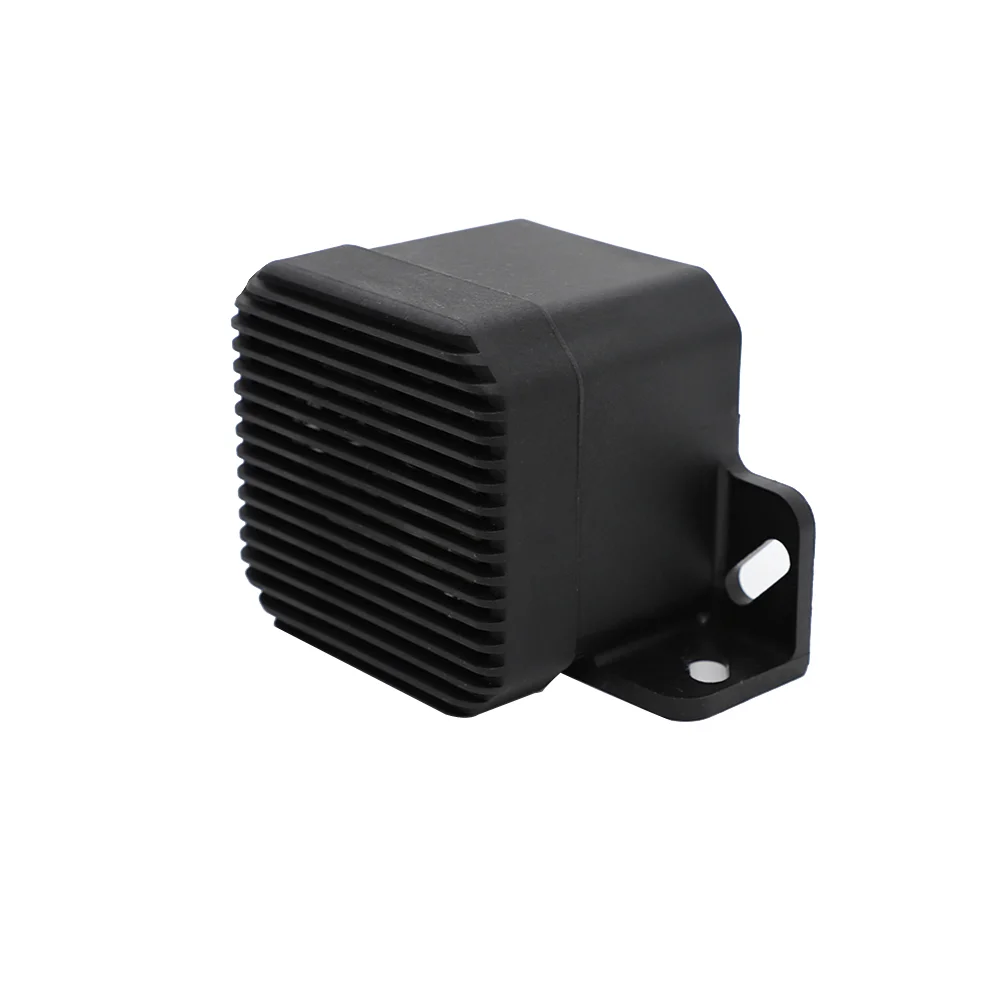
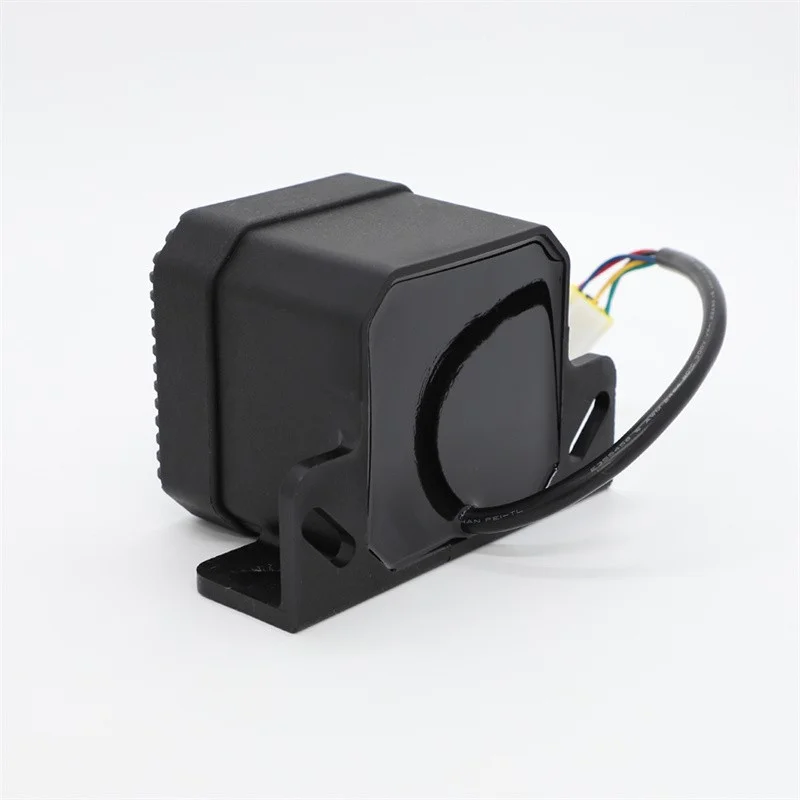
The YS-B82-5C-L-E from Changzhou Wujin Yueda Electroacoustic Equipment Co., Ltd. illustrates a practical balance. It runs on 12–24 VDC and produces 100 dBA in daytime mode and 75 dBA in night mode, measured at 4 feet. It generates a multi-frequency engine sound that simulates vehicle speed up to 20 km/h and automatically mutes above 20 km/h to avoid unnecessary noise. Reverse, left-turn, and right-turn maneuvers each get three beeps plus a spoken warning.
Directivity and durability
Directivity describes how sound spreads from the unit. A focused pattern aims the warning forward, where pedestrians approach. A broad pattern covers more angles but radiates more noise into the neighborhood. Test directivity on the vehicle, not on a bench, because mounting position and bodywork shape the result.
Durability testing exposes the unit to vibration, temperature swings, water ingress, and road spray. An acoustic vehicle alerting system mounts low at the front of the car, so it faces the harshest conditions on the vehicle. Ask for test reports, not assurances.
Poorly designed sounds can add persistent low-frequency drone to quiet residential areas, the kind that is hard to locate and slow to fade. Choose a unit whose frequency profile stays clean across its operating range.
Fit by vehicle type and use case
Cars, buses, trucks, micromobility
Match the unit to the vehicle category first. A passenger car needs a compact alerting sound that blends into a dense urban soundscape. A bus or truck operates in heavier traffic and often idles near pedestrians, so a louder daytime level and a clear reverse warning carry more weight. Micromobility platforms such as scooters and small delivery carts have limited electrical headroom and tight mounting points, so low power draw and a small footprint matter more than maximum output.
Driving conditions shape the choice as well. A fleet that runs night routes in residential zones benefits from a distinct night mode. A vehicle that works mostly in depots and yards needs a strong reverse signal. Check electrical system compatibility early. A unit rated for 12–24 VDC covers both passenger cars and heavier commercial chassis, which simplifies your spare-parts planning across a mixed fleet.
Integration and installation space
Measure the available space before you shortlist anything. An acoustic vehicle alerting system mounts at the front of the vehicle, often behind the bumper, so depth and connector clearance decide whether a unit fits at all. Confirm the wiring harness, the mounting bracket, and the service access point at the same time.
Simplified integration options shorten development. Reference designs exist that combine a microcontroller with a Class-D audio amplifier, and you can reuse them in your own layout:
The AEK-AUD-C1D9031 development board pairs an SPC58 microcontroller with two FDA903D Class D audio amplifiers to drive two loudspeakers.
Developers talk to the flash memory and the amplifier over standard I2C and I2S interfaces.
The system plays an uncompressed WAV file, so you can simulate an engine accelerating or decelerating by modulating pitch and playback speed.
Ready-to-use demo code ships in the AutoDevKit software ecosystem with a pre-recorded engine noise.
You can add the AEK-CON-C1D9031 connector board and a potentiometer to adjust volume and playback speed.
The PCB layout is reusable in the final product, and porting the platform to another vehicle needs only a power source and speakers.
Directional sound suits quiet urban streets where you want the warning aimed at the sidewalk. Object-tracking options fit vehicles that share space with cyclists and pedestrians at close range. Each approach has a place; pick the one that matches your route profile.
Regulatory compliance and certification
UN R138 and FMVSS 141
Compliance comes before performance. A brilliant unit that fails type approval is scrap metal. Two regimes dominate the global market, and you must know which one governs your vehicle.
UN R138 applies to electric and hybrid vehicles in the M and N1 categories. It covers the speed range from greater than 0 km/h up to and including 20 km/h. The regulation sets the sound level between 56 and 75 decibels, and the sound must vary with acceleration across that range. Above 20 km/h, an acoustic vehicle alerting system is not compulsory, because rolling noise becomes audible on its own. The 138.02 revision adds clearer test procedures, stationary sound requirements, and a declaration rule for driver-selectable sound modes.
FMVSS 141 governs the United States. It became effective in April 2018 and required all newly manufactured hybrids and EVs to comply starting September 1, 2020. The rule covers light vehicles with four wheels and a gross vehicle weight rating of 10,000 pounds or less. Sound must emit in forward and reverse up to 30 km/h (18.6 mph), span 315 Hz to 5000 Hz so listeners can locate the vehicle, and ramp in pitch as speed rises.
Regional variants are multiplying. Australia mandates compliance from November 2025. India targets October 2026, with decibel and frequency limits still in draft. The EU's Regulation 168/2013 sets functional safety rules for L-category micromobility vehicles.
Verifying certification
Marketing pages claim compliance freely. Documents prove it. Ask for the type-approval certificate itself, and check the regulation number and revision level printed on it. Confirm the certificate covers your vehicle category and your exact sound mode. A certificate for one variant does not transfer to another.
Run an integration test on your own chassis. Mount the unit, then measure output at the regulated speeds and distances. Compare the results against the limits in the standard, not against the datasheet. Review the sound character with real listeners in a real street setting. Certification proves legality; only your own test proves the system works on your vehicle.
Cost and total value
Total cost of ownership
Purchase price is only the first line of your cost sheet. Total cost of ownership adds installation labor, harness and bracket changes, integration testing, and the engineering hours you spend on certification paperwork. A unit that drops into your existing mounting point saves more than a cheaper unit that forces a redesign. Price the whole package before you compare quotes.
Cost tiers fit different buyers. A single-vehicle builder or a small conversion shop gets the best value from a compact, self-contained unit with simple wiring and a documented sound set. A fleet rollout spreads engineering cost across many vehicles, so a platform with reusable reference designs and consistent electrical ratings pays back faster. The YS-B82-5C-L-E covers 12–24 VDC, which lets one part number serve passenger cars and heavier chassis in the same fleet.
Warranty and scalability
Warranty coverage protects your production schedule as much as your budget. Read the terms for duration, what counts as a defect, and how fast the supplier ships replacements. Ask whether the warranty covers the unit after it has been mounted in the bumper, where road spray and vibration test every seal. A long warranty from a supplier with local stock reduces downtime on your line.
Scalability decides your cost curve across vehicle lines. A unit with a stable part number and a documented sound library lets you add models without a new approval cycle for the hardware. Confirm the supplier can hold volume as your production grows, and check that the same firmware and sound files carry over to new platforms. Plan a review point each year, because standards and vehicle lines both move.
Step-by-step AVAS selection framework
Scoring criteria and trade-offs
Build a scoring sheet before you talk to any supplier. Score each candidate from one to five on four dimensions: performance, fit, compliance, and cost. Weight compliance and fit first, because a unit that fails either one cannot enter production. Then rank the survivors on performance and cost.
Use measurable thresholds where you can. The table below shows targets you can put straight into your scoring sheet.
Metric | Threshold or standard |
|---|---|
Detection distance | target ≥20 m in 60 dB(A) urban noise |
Localization error | <15° RMS |
Compliance SPL reference | compliance-relevant SPL data per UN R138 |
Background noise standard | ISO 3744 / ISO 11201-compliant background noise (e.g., 55–65 dB(A) urban soundscapes per ISO 1996-2) |
Calibration tolerance | daily acoustic calibration (±0.5 dB tolerance) |
Mapping to regulations | directly mapping to UN R138 and FMVSS 141 thresholds |
Trade-offs decide the final ranking. Regulatory fragmentation raises validation costs, because UNECE rules serve as a baseline while the United States imposes slightly different spectral and decibel targets under FMVSS 141. That split obliges OEMs to engineer multiple hardware-software variants, and each acoustic profile must pass local certification. BOM cost pressure weighs on mass-market BEVs, and NVH trade-offs with cabin quietness targets pull in the other direction. Scaling effects are already driving down transducer and amplifier costs, which encourages faster adoption even in price-sensitive segments. Each configuration nuance gives control unit suppliers room to differentiate through software efficiency.
Calibration deserves its own line in the score. Regulators now assess frequency content, sound level, and change with vehicle speed, not just the presence of a warning sound.
"The importance of precise calibration was demonstrated by the recall of 23,700 model-year 2024 Chevrolet Equinox EVs after their pedestrian-warning system failed to provide the required relative volume change under FMVSS 141."
Final checks before purchase
Review sound character through a structured process, not a single listening session. First, brief the sonic direction as three to five audible sketches. Second, insist on parametric design, because a sound built as a system of parameters can be tuned, while a finished file can only be replaced. Third, confirm implementation in the control unit, where limited processing and memory expose weak concepts. Fourth, validate on the vehicle with the real speaker and mounting position. Fifth, run the measurement campaign for homologation. Sixth, reserve time for fine tuning, the step that separates good from very good.
Then close out the commercial and technical checks:
Supply voltage: does the unit support your vehicle's voltage, including 24V?
Inputs: can it take the signals your vehicle provides, whether CAN, digital or analog?
Sound profiles: can the sound be configured for different variants and your brand?
Mounting and protection: is the speaker suitable for outdoor mounting?
Validation evidence: can the supplier show test reports and the standards behind them?
Vehicle approval support: will the supplier help with the audibility stage on the fitted vehicle?
Confirm the acoustic vehicle alerting system meets UN R138 and FMVSS 141, and check protection class and functional safety claims against documents. A unit rated IP67 with ISO 26262 ASIL B gives you a defensible baseline for outdoor mounting. Finally, listen once more with fresh ears. An AVAS sound perceived as design has failed; it should sound functionally self-evident and still be attributable.
Performance sets the foundation. Check sound pressure, frequency range, directivity, and durability against your real driving environment. Fit comes next. Match the unit to your vehicle category, your electrical system, and the space behind the bumper. Compliance decides whether the vehicle can ship at all, so verify UN R138 or FMVSS 141 certification with documents, not marketing claims. Cost closes the loop. Weigh total cost of ownership, warranty terms, and scalability across your fleet.
Keep that order. Confirm compliance and application fit first, then optimize cost. Revisit your choice as standards and vehicle lines evolve.
FAQ
Does an AVAS need to work when the vehicle is stationary?
Yes. A stationary EV makes no noise, so the system must warn people nearby before the vehicle moves. Reverse maneuvers also need a clear signal. The YS-B82-5C-L-E covers this with three beeps plus a spoken warning for reverse, left turns, and right turns.
At what speed does the alerting sound stop?
Most systems mute once rolling noise becomes audible on its own. UN R138 covers the range up to 20 km/h, and FMVSS 141 requires sound up to 30 km/h. The YS-B82-5C-L-E simulates engine sound up to 20 km/h and mutes above that point.
Can one AVAS unit serve both a passenger car and a truck?
Often, yes. Check the voltage rating first. A unit rated for 12–24 VDC covers passenger cars and heavier commercial chassis, which lets one part number serve a mixed fleet. Confirm mounting depth and connector clearance on each vehicle before you commit.
What documents should I request from a supplier?
Ask for the type-approval certificate and read the regulation number and revision level printed on it. Confirm the certificate covers your vehicle category and sound mode. Request vibration, temperature, and water-ingress test reports. Check protection class and functional safety claims against documents, not datasheets.
How do I judge whether a warning sound is good?
Listen on the vehicle, in a real street, with real listeners. The sound should be easy to detect, easy to locate, and clearly tied to the vehicle's motion. A sound that people perceive as design has failed. Run a structured review before homologation, then reserve time for fine tuning.





View More(Total0)Comment lists